Two With Talmadge
A Pair of Silk Stockings (1918) and The Primitive Lover (1922)

O, Constance Talmadge! Expressive, fetching, lively, one of the great silent film stars. David Thomson has it right: “she had a hoydenish charm, a happy nature, and a piquant Irish prettiness. Everybody loved this madcap girl.”
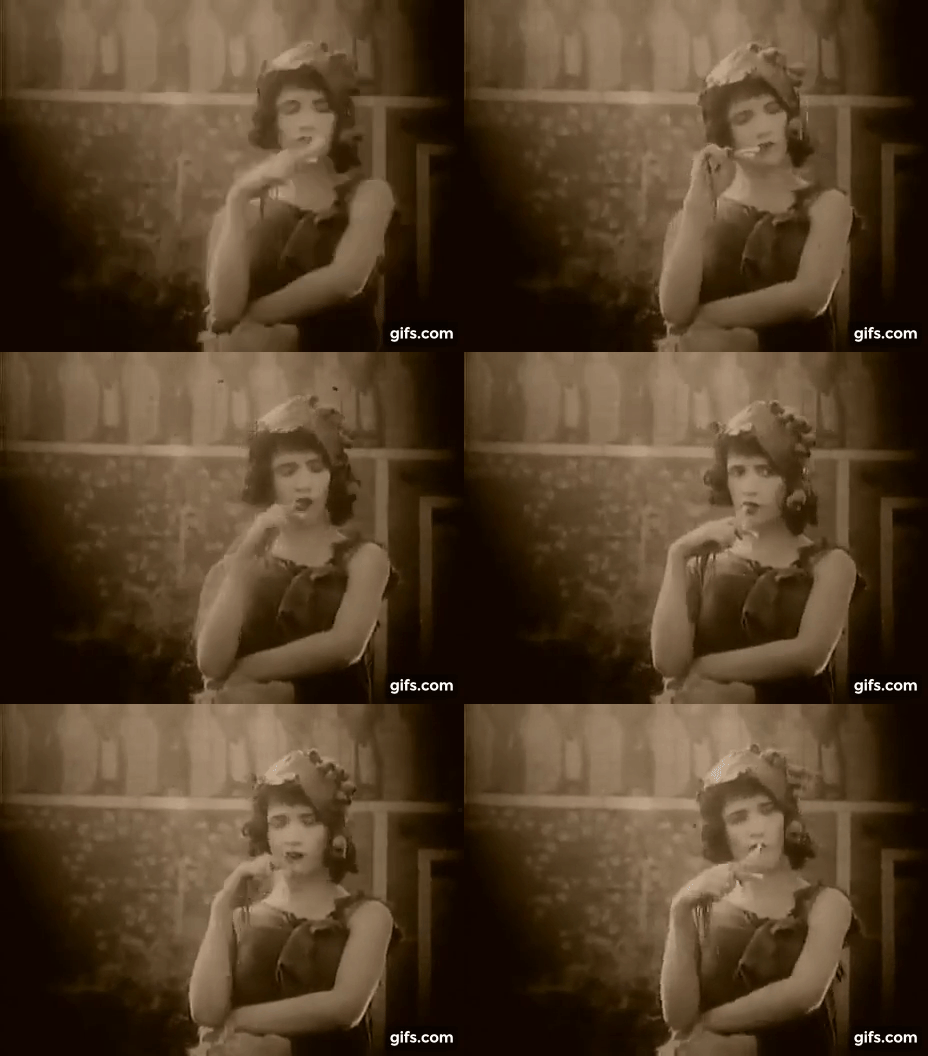
In D. W. Griffith’s three-hour-plus epic Intolerance she manages to stand out even from the thousand other characters and lavish spectacles. Her adorably barbaric “Mountain Girl” character is a kick-ass, scallion-eating warrior, lethal with a bow and every bit as impressive as any contemporary action movie boss girl.
Talmadge was Hollywood family: her older sister Norma was also a movie actress and was married to producer Joseph Schenck, her younger sister was married to Buster Keaton. She was close friends with Anita Loos. Mogul Irving Thalberg, before he settled for Norma Shearer, was smitten with her, but couldn’t hold her interest. According to Wikipedia, Talmadge was divorced three times, but her fourth marriage lasted a quarter century until her husband’s death.
She is such a delight that one doesn’t mind seeing her even in films that are by no means great, such as A Pair of Silk Stockings and The Primitive Lover.
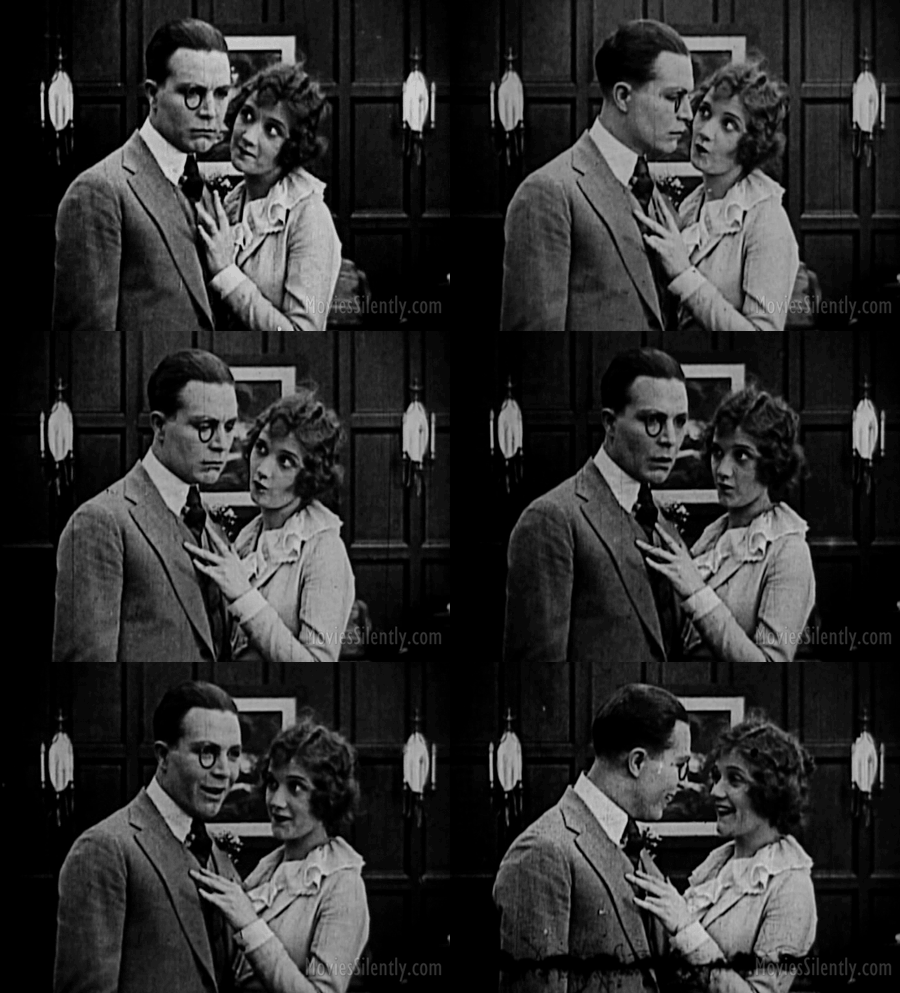
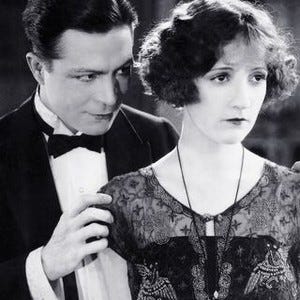
The first is a pleasant divorce-and-remarriage farce, based on a popular stage play by Cyril Harcourt, and set among the well-to-do in England. Sam Thornhill, played by Harrison Ford (no, not that one), is a stuffy, monocled sort. For some reason he is insecure and resentful about what he thinks is the lack of affection from his wife Molly, played by Talmadge.
Molly is nothing but sweet and cheerful. But when Sam gives her money to buy a new car he expects her to read his mind and, as proof that she loves him, purchase the sensible family car he prefers. (Today it would be a Subaru). He is frosty and uncommunicative when she shows him the sporty car she has bought. She deduces he prefers a more practical car and vows to herself to return it.
Alas, Sam is already embarked on a far greater display of “colossal idiocy” (as the title card says). He sends a $2000 dress from “an unknown admirer” to another woman and leaves the receipt out for Molly to find. He thinks it will make her jealous and remorseful over her “neglect” of her husband (a neglect that does not seem to exist outside of Sam’s mind). Instead, she assumes he has been unfaithful and sues him for divorce.
We get a brief courtroom scene with English barristers in wigs. The Thornhill divorce, we are told, is “the most successful divorce, socially, in years,” salacious entertainment for high society hypocrites who say they disapprove of such spectacles but lap up every detail in court as if at a sports event. Sam, typically, is unable to express himself. The court finds him guilty of adultery, and a melancholy-looking Molly wins the case.
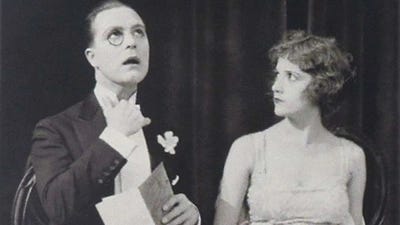
Some time later we are at a party at the home of the snobbish Lord and Lady Gower, mutual friends of the Thornhills. The guests, including the morose Sam, are about to rehearse an Ibsen play when Molly shows up unexpectedly, having walked over from a “smashup” in her ill-fated car, and not realizing her husband is there. Sam, perking up in his fake beard and costume for the Ibsen play, decides to hide in the wardrobe in the room where Molly is staying that night, as one does.
In truth, his aim is to speak with her, since she has refused to see him or even read his letters since their divorce. Meanwhile, there is a mix-up with the bedrooms and Molly’s ex-fiancé Jack shows up. When he and Molly discover the costumed Sam in the wardrobe, they take him for a burglar, overpower him, gag him, and tie him up with Molly’s silk stockings before stashing him in the bathroom.
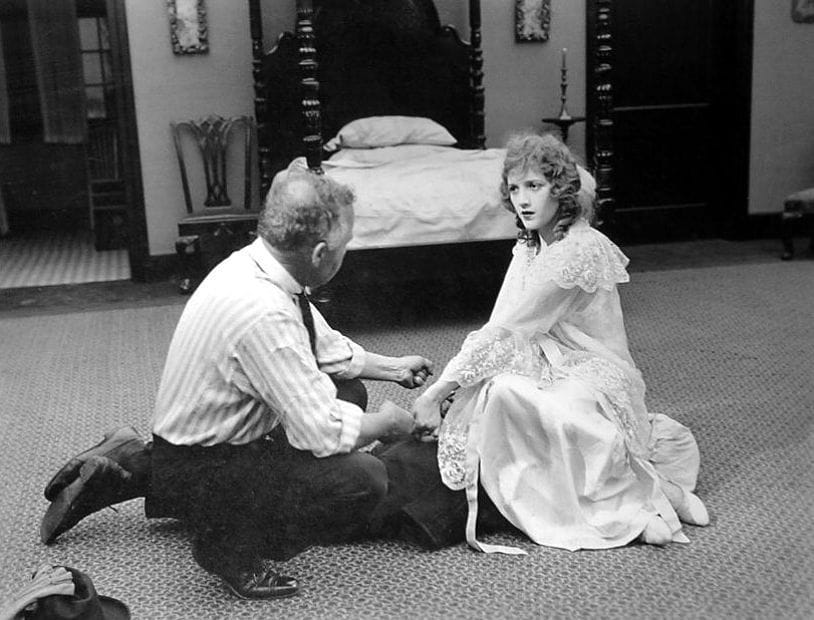
More complications: Jack’s current fiancée Pam goes to Molly’s room and, finding Jack there, assumes the former flames have reignited. By way of explanation, Jack and Molly go to reveal the “burglar,” but Sam has since escaped from his bonds and climbed out the window, returning to his own room and removing his costume. Molly’s and Jack’s reputations hang in the balance as people go off to look for the burglar they claim has escaped.
The next day, a neighborhood burglar is apprehended, and everyone is ready to forgive Molly—but she points out that this burglar is cleanshaven, while hers had a beard. Sam finally tells Molly the truth about his “colossal idiocy” with the dress. He then reveals himself to have been the “burglar,” showing her the silk stockings which he has playfully put on his own legs.
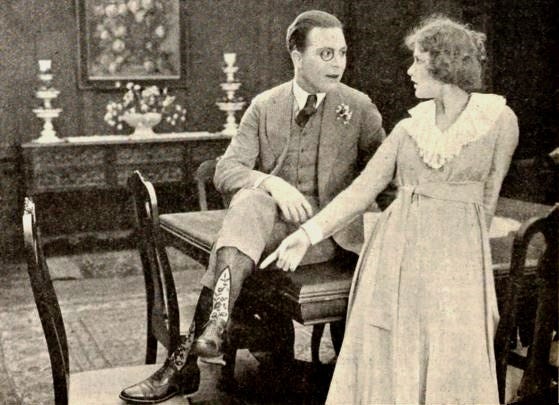
Molly in turn confesses that her car—a sensible touring car—did not crash. In fact, she came by train, knowing he was there and hoping to see him. They will get remarried. After many false starts, Sam appears to be learning how to communicate more directly with Molly, even if he remains the Subaru type.
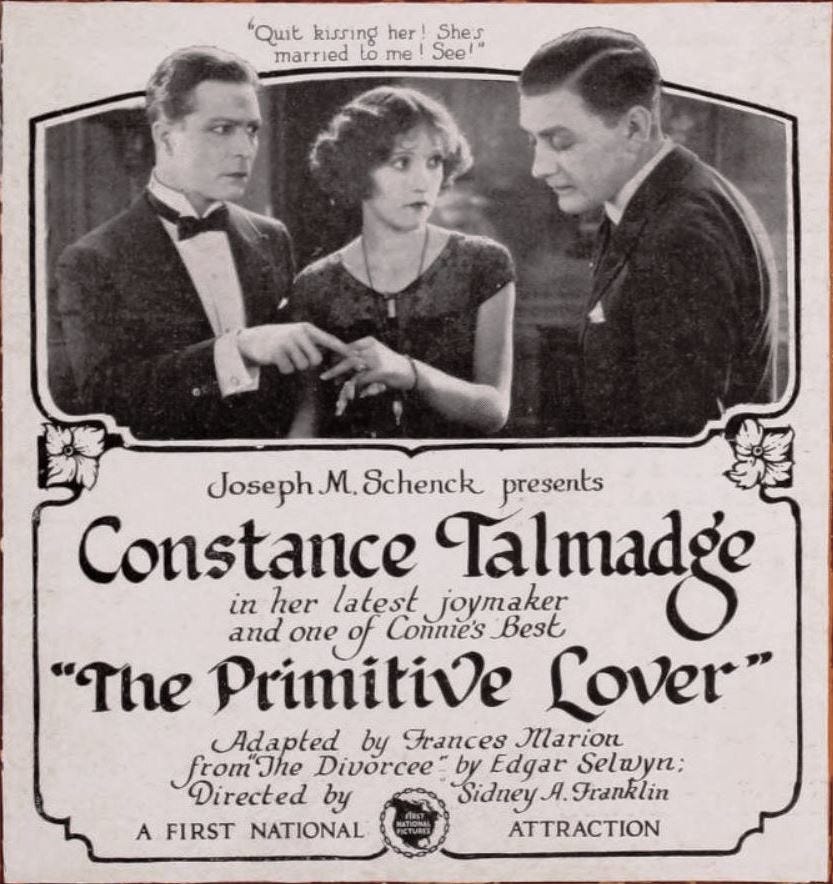
The Primitive Lover (1922) is also a pairing of Talmadge and Ford in an even more improbable divorce-and-remarriage story. Sidney Franklin directs this Frances Marion adaptation of a play by Edgar Selwyn, the co-founder with Sam Goldwyn of Goldwyn Pictures.
The best thing about this movie is the clever opening scene. We see three people on a raft in the middle of the ocean: a husband and wife (Talmadge and Ford), and a second man (Kenneth Harlan). They only have enough food and water for two. Harlan says that he will sacrifice himself—in exchange for a kiss from Talmadge. He kisses her passionately and then, as she stretches out her arms to him, clearly in love with him, he bravely throws himself into the waves.
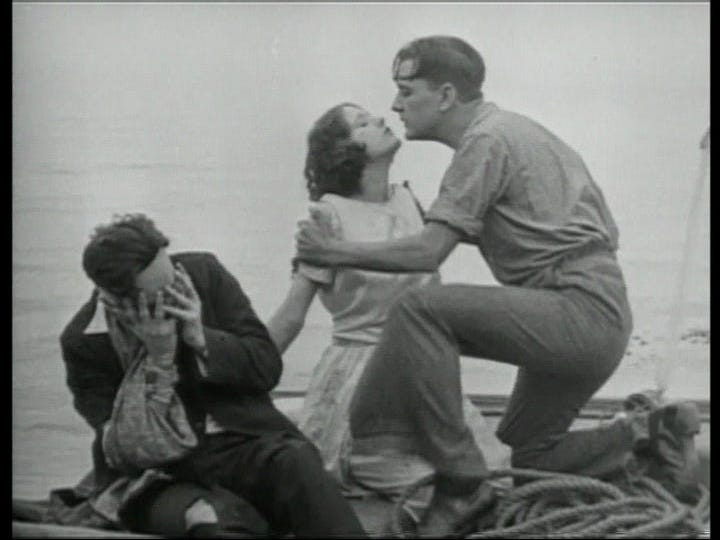
Watching all this, one is struck by the exaggerated and hokey overacting—like a parody of a silent film. Then the next scene reveals that what we have seen is not the movie, but a depiction of the ending of a novel!
Talmadge is reading the novel, titled The Primitive Lover. It was the last thing written by her former fiancé (Harlan) before he died on a dangerous wilderness expedition. She is now married to Harlan’s friend (Ford), a milksop in comparison with the dashing Harlan, whose memory casts a shadow over their marriage.
And not only his memory, since Harlan’s “death” turns out to have been a publicity stunt to boost sales of his new novel. When Harlan shows up in the flesh, Ford meekly steps aside, even accompanying Talmadge and Harlan to Nevada to facilitate the divorce. Yet afterwards, Talmadge berates Ford for giving up on her so easily. She never really wanted the divorce, she tells him, but now feels justified seeing what a doormat he is.
What Ford needs, of course, is the advice of an Indian chief, played by Native American actor John Big Tree. Ford admires the way the chief rules confidently over his 22 wives. “Man never wrong,” the chief explains to Hector, “squaw just humble dog, no got right to back talk.” Happy to smack his wives around, he explains that women “like ‘em heap rough stuff.”
Taking this relationship advice to heart, Ford forces Talmadge and Harlan at gunpoint to a remote cabin, pointedly leaving them with only a copy of Harlan’s novel The Primitive Lover and its account of his excellent survival skills. As Ford has figured out, Harlan is a tough he-man in his books, but not very capable in real life. In fact, Harlan soon runs away. Ford has meanwhile paid the Indian chief to stay out of sight but hunt for food, making it look like Ford is the capable wilderness man. Talmadge is impressed.
Ford truly proves his mettle when he fights off a sinister cowpunch who tries to assault Talmadge. Harlan returns with the sheriff to claim Talmadge, but she gets news that her divorce decree was actually never finalized. She rejects Harlan in favor of Ford. The chief congratulates Ford, feeling vindicated that, indeed, women “like ‘em heap rough stuff.”