Collapse, 1965 – 1969
Marriage and Movies on the Rocks

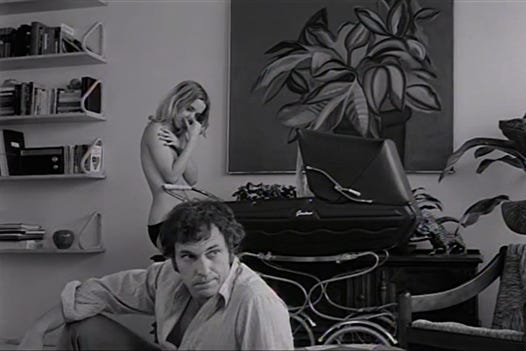
The second half of the 1960s witnessed a precipitous acceleration in the increase of American divorce—and a nadir for the Hollywood studios in terms of movie attendance. Both trends are on display in the films of this period, though less in terms of portraying divorce itself than of dramatizing the utter pointlessness of marriage.
“Why do people get married?” asks Catherine Deneuve in the romantic comedy The April Fools. “I don’t know,” Jack Lemmon responds, “they do.” In Marriage on the Rocks, Deborah Kerr wants to divorce her husband, and her lawyer tries to argue her out of it. Sort of.
Lawyer: You feel marriage is outdated?
Kerr: Yes, I do! I think it’s putting a permanent solution to a temporary nervousness.”
Lawyer: Would you tell that to your daughter?
Kerr: I might.
Lawyer: Well, don’t! Marriage isn’t perfect but it will have to do until we think of something better.
Dick Shawn, in The Happy Ending, remarks: “American married people are 32% divorced and 68% miserable.”
The movies of this period are like wolves tearing apart the carcass of marriage—and tearing apart the meaning and worth of an American cinema that had long assumed marriage to be its default moral horizon, even when divorce was a theme.
The fifteen movies we’ll look at in this post show the flailing death throes of “Old Hollywood”: crass and cringe-inducing attempts to find relevance and engage the youth culture, often mere displays of lechery and moral hypocrisy. Yet the emergent “New Hollywood” was at this point not terribly interested in marriage or divorce. Indeed, if one takes the impotent Clyde Barrow (played by Warren Beatty in Bonnie & Clyde) as a bellwether, the New Hollywood was not especially interested in male-female eros, period.
Serious and cinematically satisfying portrayals of both marriage and divorce in a very new social landscape would come in the 1970s. But tracking divorce in the movies of 1965 to the early 1970s reveals—with a few ambivalent exceptions—a dispiriting and ugly chaos, a painful roster of failure, sometimes aesthetic, sometimes moral, often both.
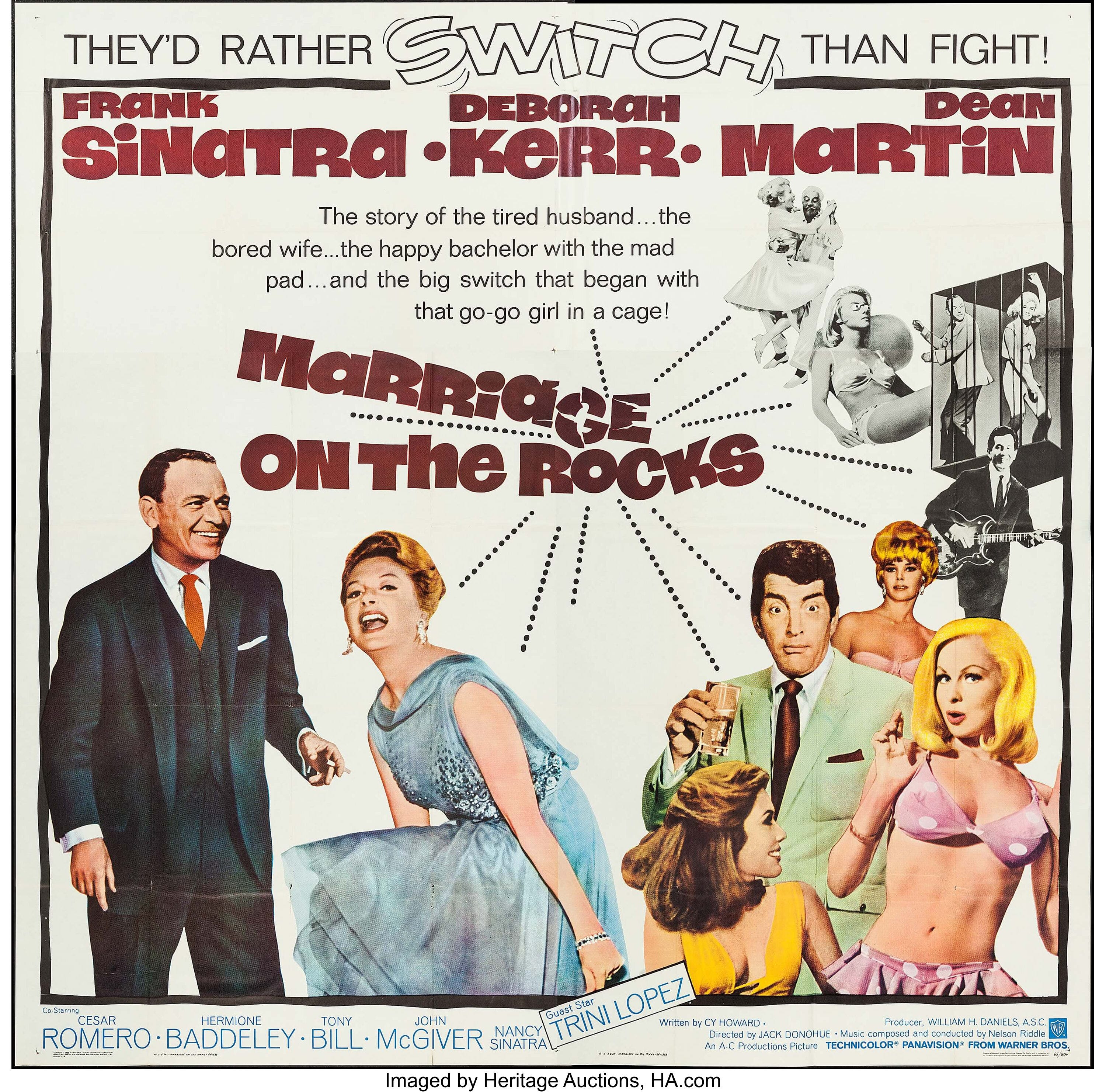
Marriage on the Rocks (1965)
Frank Sinatra is a boring corporate suit who ignores his wife (Deborah Kerr, lively if misused here), while his best friend Dean Martin seems to be having all the fun with the bikini-clad minxes who throng his groovy bachelor pad. The film’s structure is comedy-of-remarriage, but without the faintest trace of joy or romance or idea that marriage might have worth. Instead, the movie possesses the smug, late-1960s cynicism I had (in another post) located in the 1967 movie Divorce American Style. Turns out, a working title for Marriage on the Rocks was “Divorce American Style.”
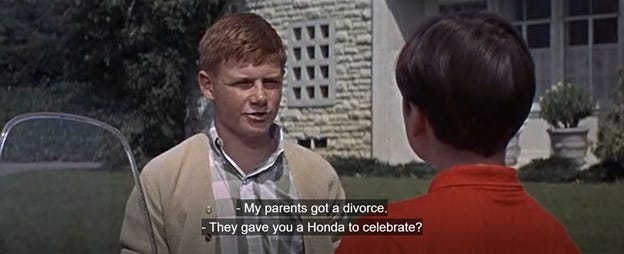
As in Divorce American Style, Marriage on the Rocks features a running gag that children don’t mind at all when their parents divorce, and even welcome the opportunity to exploit their parents’ guilt. When the family lawyer tries to dissuade Kerr from divorcing Sinatra, she tells him: “Practically everybody in my neighborhood is divorced. My children feel strange and left out.” Sinatra and Kerr’s young son is coached by a buddy on how to get presents when his folks split up. “My entire life has been changed since that wonderful thing happened,” the friend says, showing off his new Honda motorbike.
The movie gives us three options: 1) married life (boring, passionless), 2) bachelor life (Martin’s Playboy-mansion apartment and its brainless sex objects), and 3) the world of the younger generation who apparently spend all their time doing arm-flailing dances at the go-go club. This last set of tropes—the younger set with their rock n’ roll music and weird dances, the eye-rolling of the older generation (along with the leers of the older men at the mini-skirted teenyboppers around)—spreads like mold across the movies of the period, and is simply an even cruder continuation of 1950s clichés.
Sinatra and Kerr have a teenaged daughter, played by Sinatra’s daughter Nancy, who wants to move in with her cool friend Lisa (Davey Davison) who is a dancer at the club—and who we learn is from a broken home herself and yearns for family stability. Perhaps, then, the movie really pro-marriage? No. As Kerr tells her lawyer, marriage is “putting a permanent solution to a temporary nervousness.” It is, at best, a placeholder, and already outmoded.
When the movie was being made, Sinatra had been divorced twice (Mia Farrow would make it three); Martin, twice; the director, twice; the screenwriter, twice. The screenwriter was Cy Howard (born Seymour Horowitz) who, like Norman Lear did as screenwriter for Divorce American Style, brings a kind of television-writing crassness, with a pretense toward social satire that comes across as mere dysfunction.
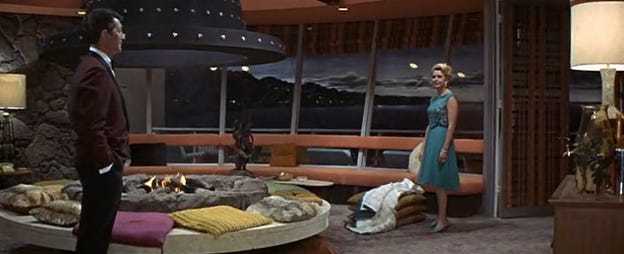
Bosley Crowther called Marriage on the Rocks “a foolish and witless piece of nonsense.” Is there anything good in it? Cheesy as it is, Martin’s split-level bachelor pad, with its shag rug, fake stone, leather doors, and fire pit dominating the living room, is a thing of wonder.
When The Boys Meet The Girls (1965)
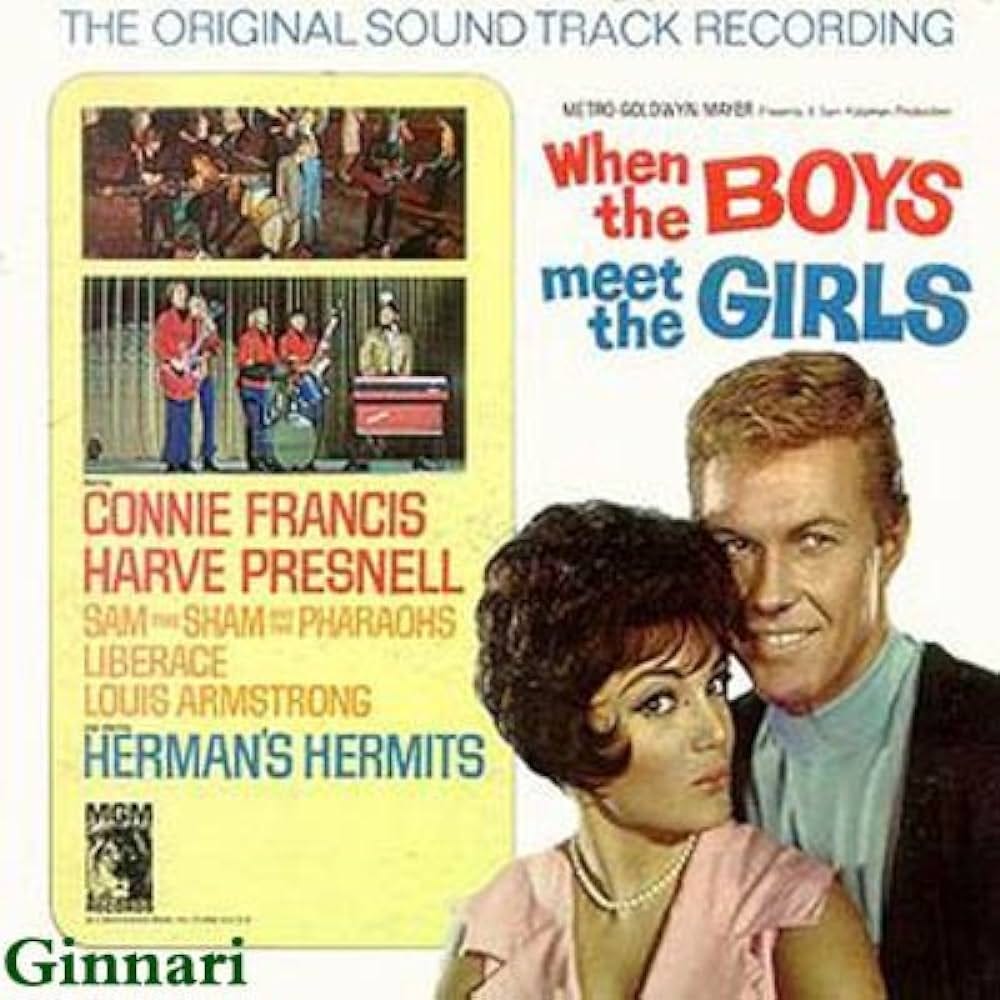
Inept and cynical attempts to tap into the youth market while still holding onto an older demographic continued apace. When The Boys Meet The Girls, which for some reason ends at a divorce ranch in Nevada, mixes Gershwin tunes (the movie is a quasi-remake of the 1943 Judy Garland-Mickey Rooney Gershwin musical Girl Crazy) into a vehicle for Connie Francis, along with performances by Louis Armstrong, Herman’s Hermits, Sam the Sham and the Pharoahs, and Liberace. Some playlist.
Strange Bedfellows (1965)
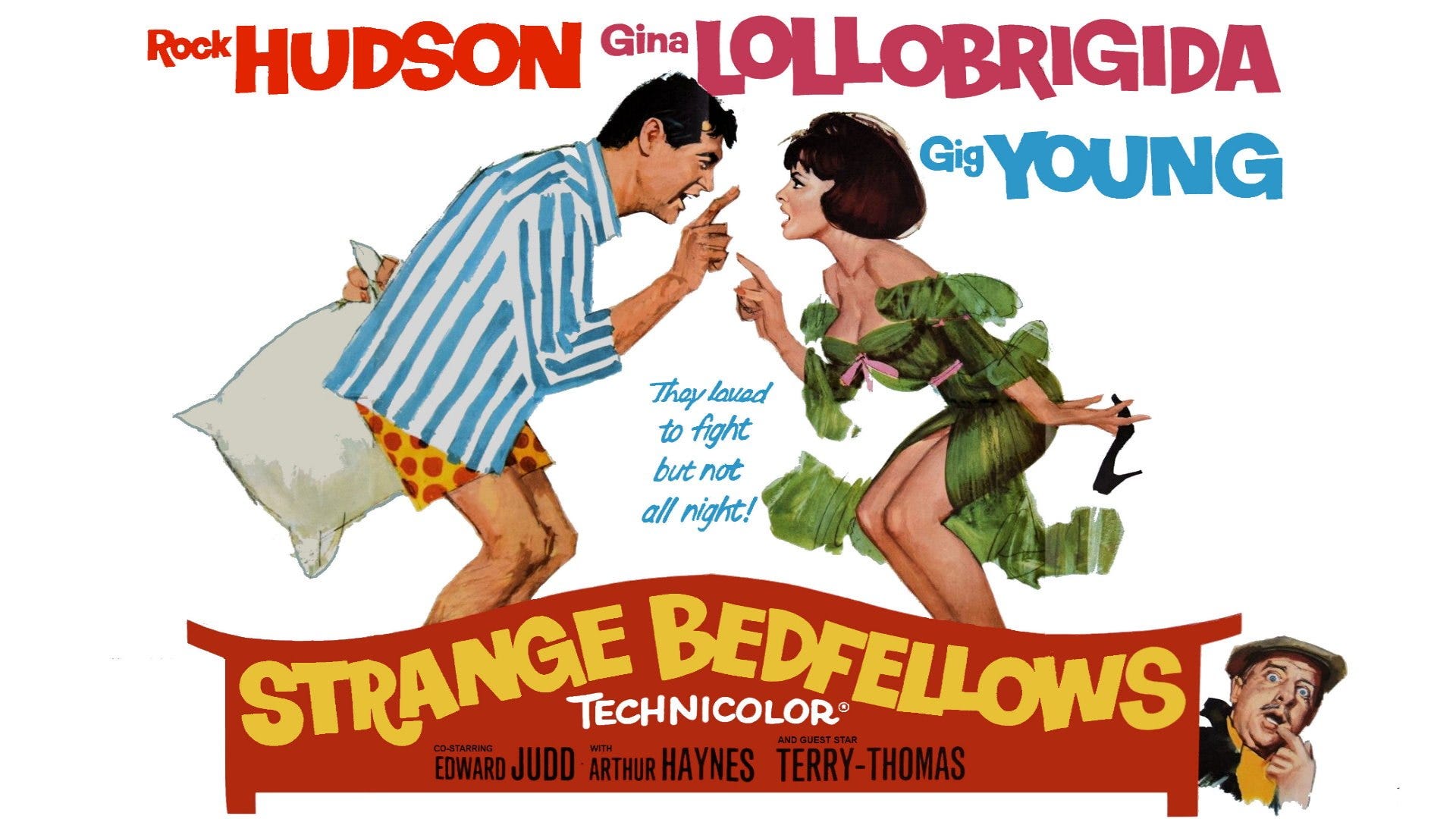
Rock Hudson works for an American oil corporation. The obstacle to his promotion is his wife, Gina Lollobrigida. Although they have been separated for years—he’s a company man, she is a bohemian with a Mediterranean temper—they are too attracted to each other to go through with the planned divorce. Lollobrigida’s countercultural proclivities are signaled by her bearded friends, unfinished demonstration sign (it says DOWN WITH B, we never get to find out what it is she opposes), and her nude protest at the American embassy. Another loud and artificial comedy-of-remarriage.
Harper (1966)
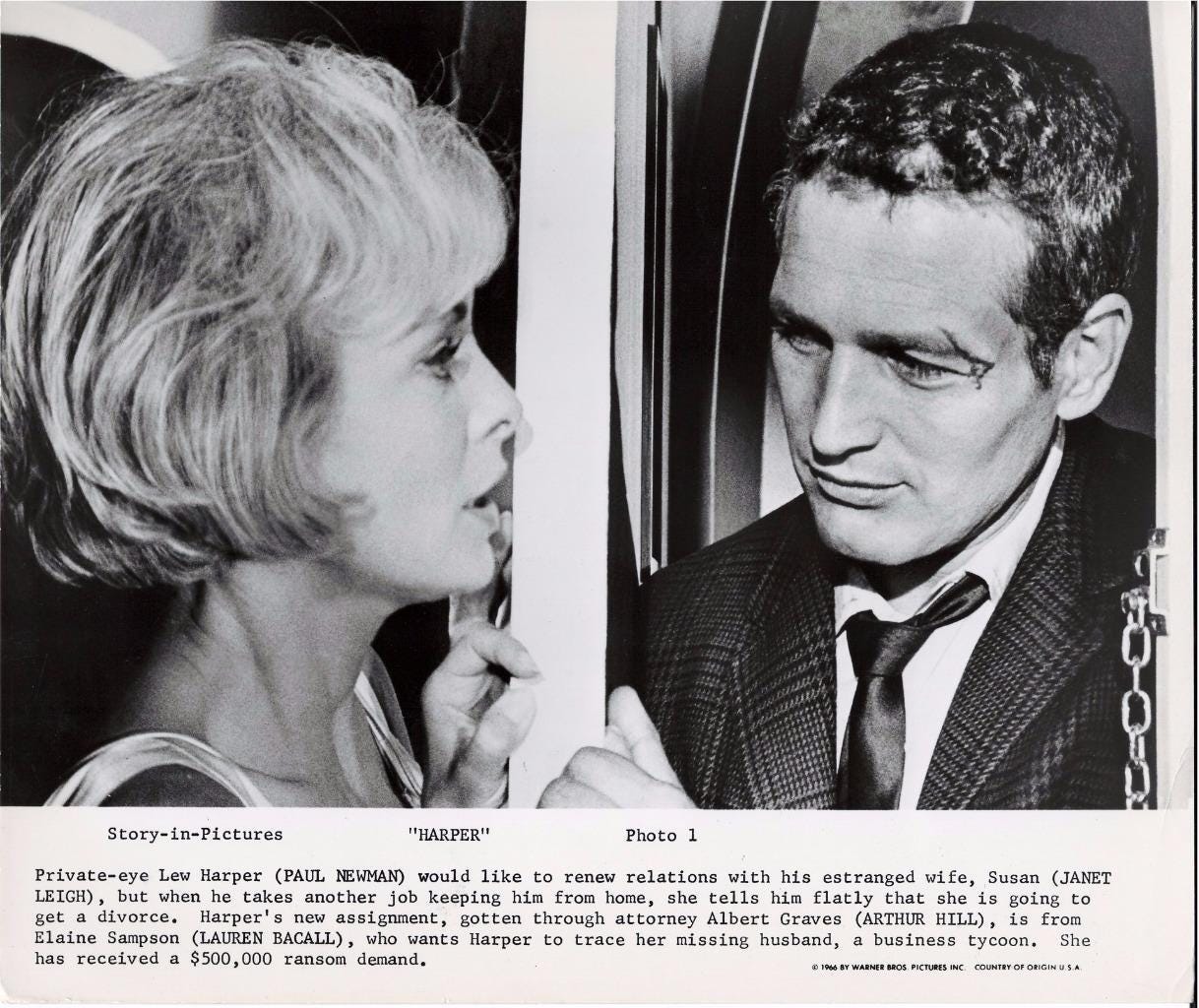
Before divorce broke into the mainstream, it was a common feature in the demimonde of crime fiction and pulp noir. Divorcees make for dangerous and complicated seductresses, and divorce is a frequent part of the private eye’s distance from respectable society. In Harper, Paul Newman plays Lew Harper—renamed from L.A. noir master Ross Macdonald’s Lew Archer in the source novel, The Moving Target (1949). Southern California depravity offers up a host of awful people given great expression by Lauren Bacall, Shelley Winters, Pamela Tiffin, Robert Wagner, and others.
For our purposes, the center of the movie is Newman’s few minutes with Janet Leigh, his ex-wife, who calls him “a degenerate’s degenerate” and is irate because his new case is keeping him from getting their divorce finalized. After Newman gets beat up, he knocks on her door, looking for solace. “I’m not even sure I like you,” she says, before they sleep together.
This is divorce world, not comedy of remarriage. The protagonist may still orbit the ex-spouse, exploiting, provoking, but without any real desire for reunion. Private eyes and maverick lawyers are particularly suited to this. Peter Falk in the television series Trials of O’Brien (1965-66) is a case-cracking lawyer who turns to his ex-wife Joanna Barnes for occasional help. Barnes is relatively cooperative but smarter than Janet Leigh about getting emotionally involved. Closer to our day, in The Lincoln Lawyer (2011) Matthew McConaughey sleeps with ex-wife Marisa Tomei, and they even cuddle with their young daughter in the morning—but there is no expectation by anyone (except their daughter) that they’ll get back together.
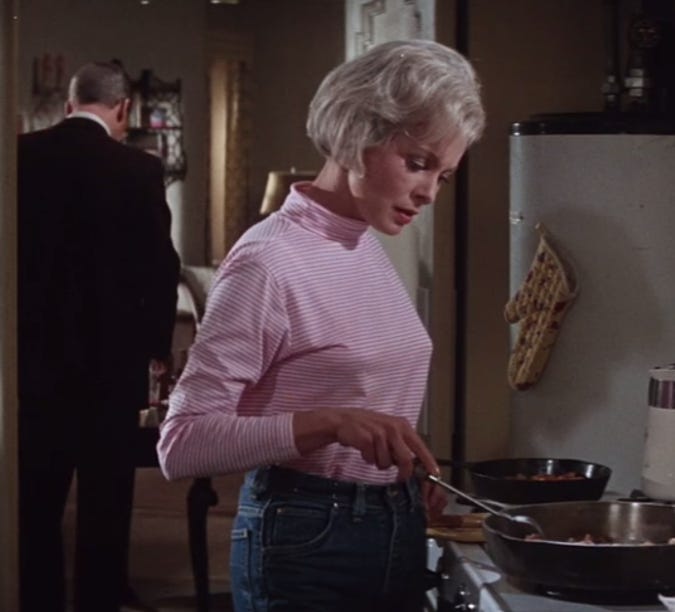
In Harper, we see Leigh the next morning, happily, hopefully making Newman bacon and eggs. She looks at his bruised face when he walks in the kitchen, seeing immediately that he has no intention of staying. Her face falls. “Just an infinitely lingering disease,” she says as he walks out, and then she stabs the yolk of each egg in the pan.
Two For The Road (1967)
The theme running through these movies is not that divorce is a good, but that marriage is joyless and without sense, at best a kind of idiosyncratic exercise in stoicism, at worst a spectacle of interlocking sadism and misery. 1966 gave us one of cinema’s most hellish marriages—but so gloriously realized—in Who’s Afraid of Virginia Woolf? with real-life couple Elizabeth Taylor and Richard Burton. In 1967, Taylor, almost as brilliantly, tortured her repressed homosexual husband Marlon Brando in the twisted, gorgeously amber-tinted gothic tragedy Reflections in a Golden Eye.
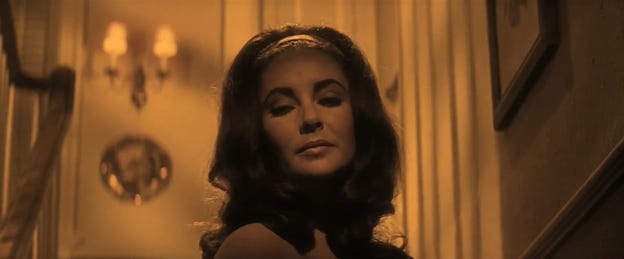
But the movie of 1967 that mounts the most relenting assault on marriage under the guise of a paean to it is Stanley Donen’s Two For The Road. With much clever and intricate chronological skipping back and forth across the dozen years of their courtship and marriage, the movie gives us Audrey Hepburn and Albert Finney on the verge of marital failure. Hepburn does finally have an affair, and one can’t blame her since Finney spends the entire movie enraged at the universe for having saddled him with a charming and loving wife. It doesn’t make sense, but their marriage doesn’t make sense either—which may be the point.
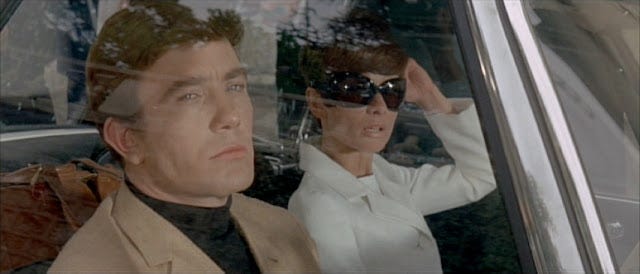
Film scholar Jeanine Basinger finds the movie, which she calls “the story of a marriage in a world in which marriage has grown unnecessary, featuring a couple adrift emotionally in a world of easy money and sex,” to be cinematically persuasive, its fractured temporal sequencing the correlative of a fractured institution. “A marriage story—for a 1967 audience,” she writes, “can no longer be simple and, thus linear.”
I don’t agree. The movie’s time shifts seem to me not meaningful but gimmicky, if very well executed, and the parade of automobile designs and fashion (Hepburn wears a kaleidescope of 60s outfits from the chic to the improbable) like fancy wrapping for the dismal nullity of this unhappy union.
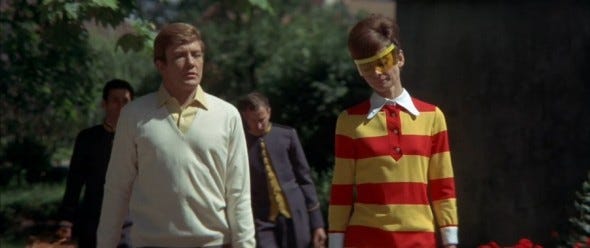
There is a little exhalation of intimacy and love between Hepburn and Finney at the very end, but not enough to justify the cruelty of their being together. Basinger states that, if we reorganize Two for the Road into its real chronological sequence, we will find a chronicle of “marital happiness established, destroyed, and, if not fully reassembled, at least maintained.” I don’t see the happiness, except as a few very brief flashes—and what is maintained at the end seems like masochistic inertia. The last words we see them speak to each other, said smiling as they kiss at the film’s end:
Finney: Bitch.
Hepburn: Bastard.
Perhaps Bonnie and Clyde, from the iconic film of the same year, came out ahead in being torn to bits by tommy guns rather than each other.
Luv (1967)
The Broadway play by Murray Schisgal that Luv is based on ran for hundreds of performances, but the film is the bad sort of Jewish comedy of the 1960s, straining for sophistication but just being crass, posing as satirical when it is merely rudderless.
Milt wants to divorce his wife Ellen so that he can marry the sexy Linda. He pairs Ellen off with the suicidal Harry. Turns out that Linda is no catch, and Ellen and Milt still love each other—so they try to pair off Linda with Harry. All four wind up falling into water. The end.
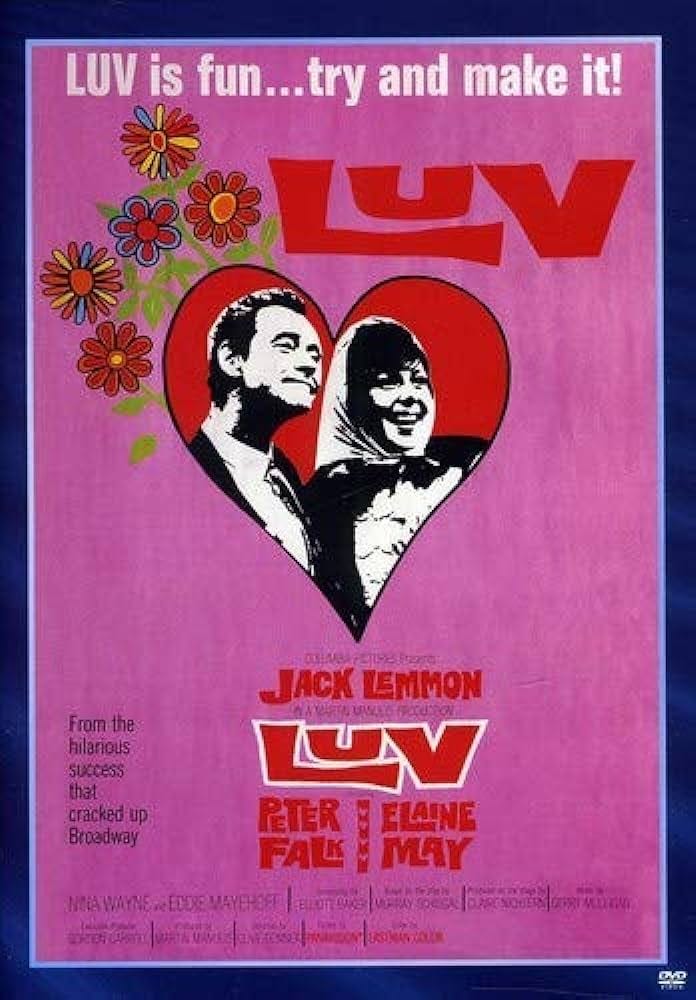
If Luv’s characters were more Jewish, with a real and specific sociology entailed, rather than presented as some kind of universal American middle-class types, it would be a better movie. Yet Harry is played by the too Gentile Jack Lemmon, just as Dick Van Dyke would have the lead in Divorce American Style. Jewishness and divorce were not yet ready to be treated explicitly and without defensiveness, though they would in the 1970s to often brilliant effect.
The possibility of a better, more Jewish, or at least less empty, incarnation of Luv is seen in its casting of Peter Falk and Elaine May as Milt and Ellen. May especially—sexier than the blonde her husband chases, and radiating a far weirder energy than anything else in the movie—gives the film its few moments of sublime comic inspiration. Ultimately, this film belongs on the heap of failed comedies of remarriage, along with Marriage on the Rocks, Strange Bedfellows, and Divorce American Style.
Even Charlie Chaplin failed in 1967 with A Countess from Hong Kong, a comedy in which Marlon Brando divorces Tippy Hedren and falls for Sophia Loren. Chaplin’s final film is an attempt at Lubitsch farce, but without timing or joy, Brando mumbling lines that ought to be delivered crisp as fine champagne. In the whole production only Angela Scoular really catches the spirit Chaplin sought to revive, in her minor role as a drawling society girl: “You don’t believe in the soul?! Daddy does.”
Don’t Make Waves (1967)
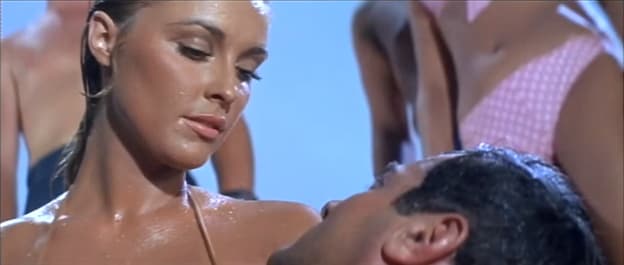
Yet screwball comedy in 1967 was not completely lost. It just had to get weird enough, dark enough for the times. The Producers was the year’s best-known example. Another, more interesting film was Don’t Make Waves.
It was panned by some critics as a bad California beach comedy, and it certainly has girls dancing in bikinis, body-builders flexing, and a surf bunny named Malibu. Yet the movie is no Beach Blanket Bingo. Andrew Sarris called it “one of the more underrated comedies of the season.” There is dry humor, smart comic pacing, and a certain British charm: Alexander Mackendrick, the director, also did The Ladykillers with Alec Guinness. Tony Curtis is wonderfully deft and subtle in the leading role.
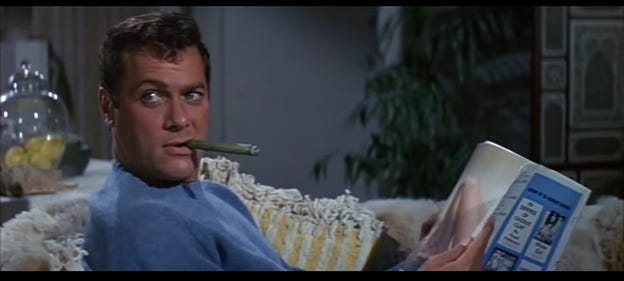
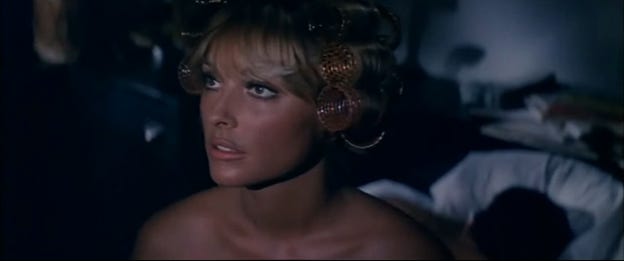
There is a pre-Manson darkness at the film’s edges, the fraying, entropic feel of the southern California of Thomas Pynchon or Joan Didion. The opening title sequence features trippy animation and a song performed by The Byrds. We never really learn who Curtis is or what he is doing there. Philip Lathrop’s expert cinematography adds to the end-times feel, especially when the Pacific looks gray and cold. Robert Webber, having an affair with Claudia Cardinale, tells her that she has to stop taking “those sleeping pills.” Edgar Bergen has an odd little role as a corrupt astrologer. A photographer died filming the movie’s skydiving sequence. In one strangely eery scene, Sharon Tate is in hair curlers watching Spanish television all night until the test pattern comes on.
Admittedly, this isn’t much of a divorce movie, but I include it because Joanna Barnes discovers Webber’s affair and plans to divorce him. In the movie’s final scenes, all the characters are trapped during a mudslide in a house that turns over and over, floor becoming ceiling, as it slides down to the Pacific. They all crawl out onto the beach at dawn, looking dazed and shaky as newly born colts. Curtis and Cardinale start running along the beach, and you half expect to see the Statue of Liberty sticking out of the sand.
The Trip (1967)
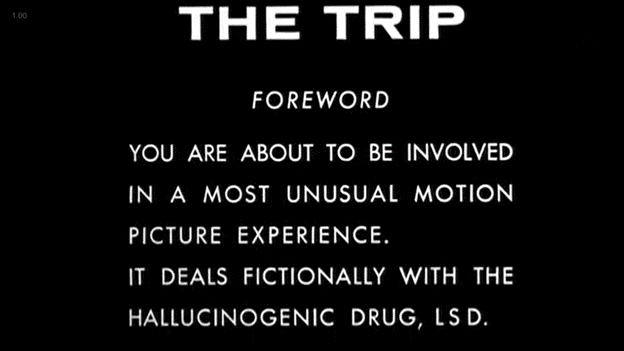
The most unlikely divorce film of the late 1960s is The Trip, the cult LSD movie directed by Roger Corman, starring Peter Fonda, Bruce Dern, and Dennis Hopper, with a screenplay by Jack Nicholson. Given all the countercultural significance of the movie, we might forget that it opens with Fonda and his wife, played by Susan Strasberg, arranging their divorce. Fonda’s subsequent acid trip is, therefore, his launch into Divorce World—ending, as often happens, in bed with another woman.
Despite the focus on hallucinogens and California drug culture, and the psychedelic visual effects, The Trip is conventional in structure and even, to some extent, in outlook. Fonda’s break from ordinary bourgeois morality, signaled by both his divorce and his decision to try acid, is not unambiguously celebrated. He is lost and idiotic. His two friends, Dern and Hopper, are each flawed. Dern is conceited, not nearly as aware and enlightened as he pretends to be. Hopper is a predatory creep who only cares about himself. Both swim easily through a counter-culture that rewards their disordered narcissism.
And the movie ends with quirky deflation. Fonda wakes after sex and the woman he is with asks him if he found the insight he was looking for. He says that he did, that he loves her and loves everyone. “It’s easy now,” she responds. “Wait till tomorrow.”
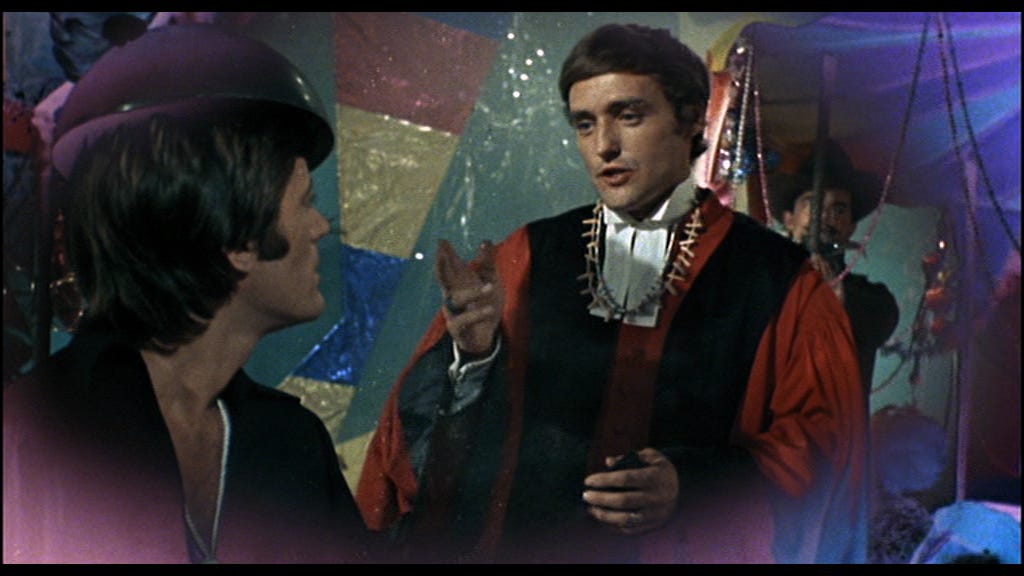
Tellingly, there is a scene in which Fonda—high as a kite—walks into the house of an ordinary family at night. A little girl wakes up, and Fonda gets her a glass of milk. The family represent a normalcy and decency that has been abandoned by the counterculture. When the girl’s father wakes up, understandably angry to see a stranger in his house, Fonda runs away.
The Odd Couple (1968)
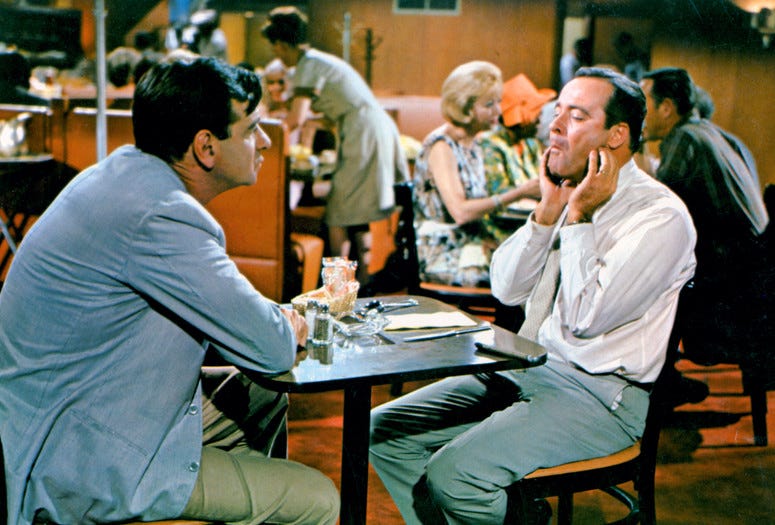
The Odd Couple adds to the period’s sense of marital claustrophobia through its premise: that the misery entailed by marriage may not be something we can escape even after divorce. Split from their wives, Jack Lemmon and Walter Matthau simply recreate their roles of unhappy spouses. The film was hugely successful—and spun off a successful TV sitcom—but its one joke, that the two divorced men “marry” each other and replicate their marital failure, doesn’t have much staying power today.
Hellfighters (1968)
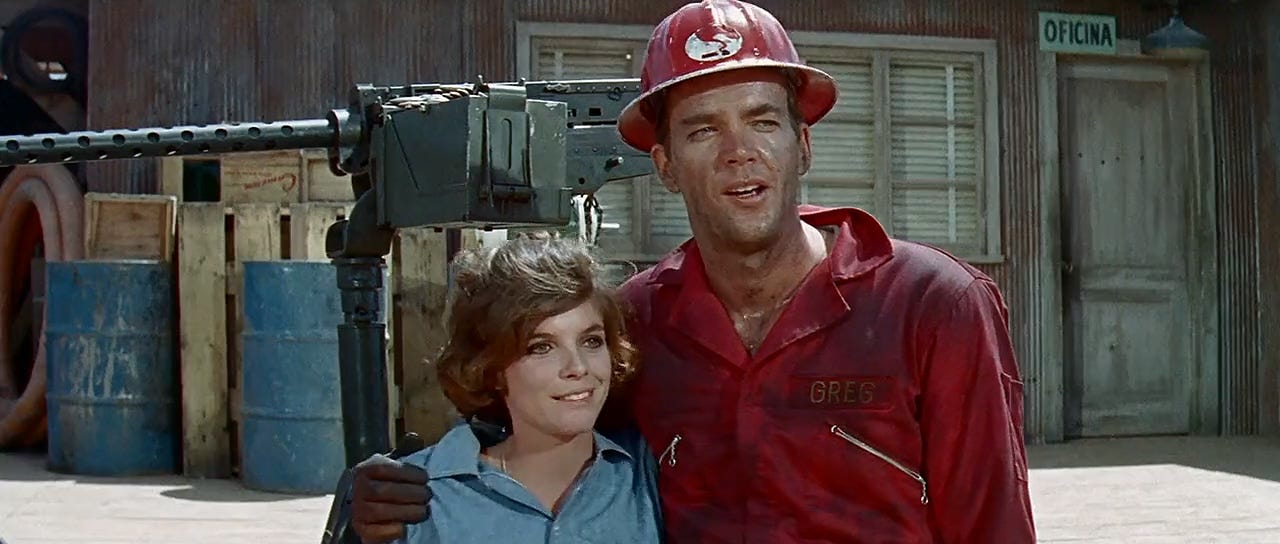
1968 also saw Hellfighters, another John Wayne movie that tries to push back on divorce culture via Hollywood manliness. Wayne is a legendary fighter of oil fires, whose wife divorced him twenty years ago because she couldn’t live with the risks he faces in his job. They reunite when their daughter, played by The Graduate’s Katharine Ross, also falls for an oil well fire fighter. We see that , when men are allowed to be men, and their women support them, they triumph over all—even over a multi-well fire under attack by Venezuelan guerillas. Even over divorce.
(The great divorce movie of 1968—and one of the best in all of cinema—is Richard Lester’s Petulia, the subject of my very first post.)
The April Fools (1969)
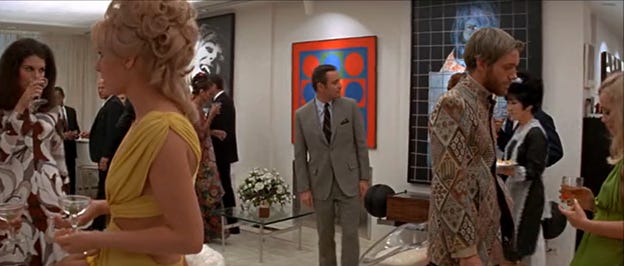
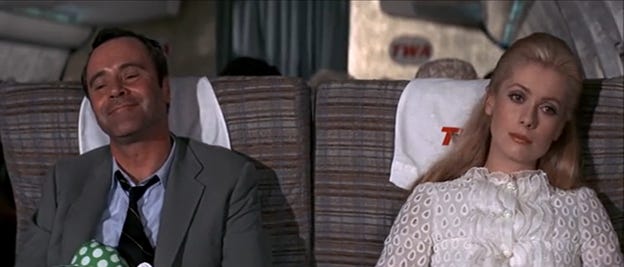
The April Fools opens with one of the most strikingly filmed 1960s parties, though the people at the party, and their clothes, are eye-poppingly dreadful—with the exception of Catherine Deneuve, all placid face and saintly eyes. Inexplicably, she falls for Jack Lemmon’s sweaty, weak, stammering loser of a character. Both are unhappily married, Deneuve to Lemmon’s wealthy boss (Peter Lawford), who philanders but wants to hold onto Deneuve as a trophy, and Lemmon to a castrating taskmaster (Sally Kellerman).
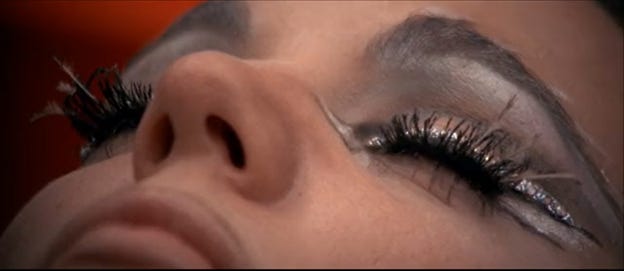
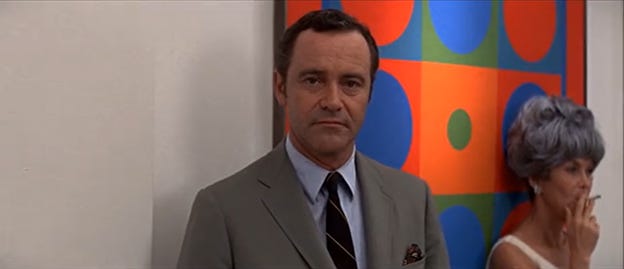
In the course of a single night, Lemmon and Deneuve fall in love, while making their way through various period hells: a “Safari Club” restaurant in which men shoot pop guns at the waitresses’ bottoms when they want to order, a dance club with its disorienting lights and flailing hipsters. They are briefly rescued by a charming older couple, Myrna Loy and Charles Boyer, who provide a temporary oasis of charm and affection in the midst of the decrepitudes of “youth culture,” a reminder of what real bon vivants once were. Montage spares us the absence of any rationale for Lemmon and Deneuve’s relationship. Lemmon thinks of himself as a frog who has found his princess. Deneuve simply looks at him with her gently pitying eyes.
Lemmon ultimately decides to quit his job, leave his evil wife and feral son, and join Deneuve on her flight to Paris. He is nearly undermined by two friends. One is a lawyer, also unhappily married, but whose misery wants company: “Ya know how many divorces I handle a week? And every time I say, O Lord, this time let it be mine!” The other is Harvey Korman, superb as a weirdly menacing businessman type, shamelessly soused. You can smell the alcoholic sweats of both men. Neither can imagine the love that Lemmon professes to feel for Deneuve, but interpreting it as a sex thing they nevertheless get him to the airport, driving drunk at night to a jaunty Marvin Hamlisch soundtrack.
Visually, the movie is period heaven; as a love story it is implausible and dispiriting. Deneuve is a fantasy, a blank. Lemmon seems tainted with the same ugliness of spirit all around him. Everything in the film must stink of cigarette smoke.
How To Commit Marriage (1969)
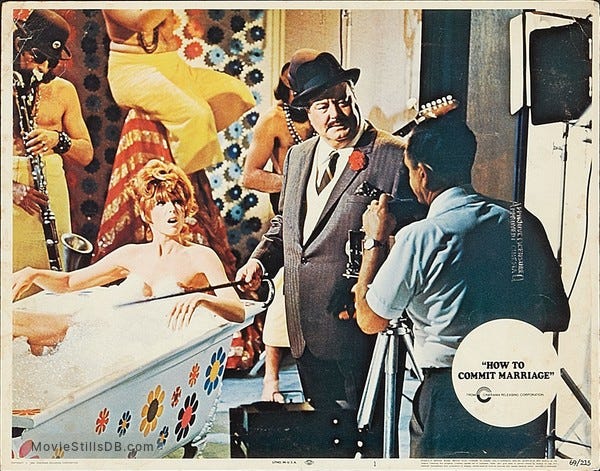
Jane Wyman and Bob Hope divorce in How to Commit Marriage, another cringe-making attempt to straddle generations and audiences with aging movie stars and youth culture trappings. The opening sequence gives us a series of petty marital annoyances—his golf ball is her shoe, she hogs the blankets—and so Wyman demands a divorce from Hope. But before they complete the paperwork, their daughter Nancy comes home from Berkeley with fiancé David in tow, and since the kids are set on a church wedding and idealize her parents, it just isn’t time to break the sad news.
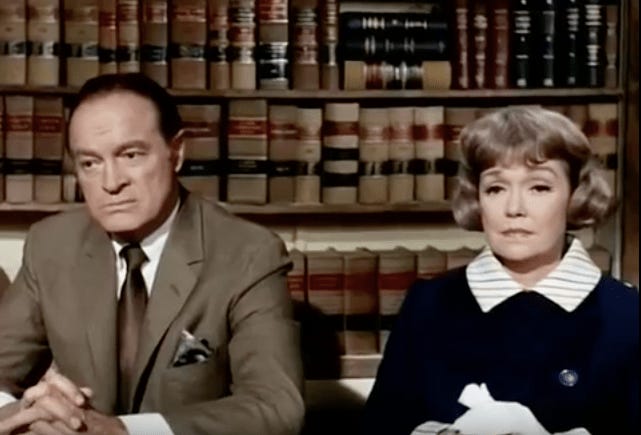
Where does the counter culture come in? Well, Nancy and David may seem like clean-cut, white bread, suburban kids, but they are also disciples of “the Baba Ziba,” a cartoonish guru played by Irwin Corey. And David’s father, a sleazy rock impresario played by Jackie Gleason, convinces them to join a band. (This is an actual band from the time, The Comfortable Chair, whose members look decidedly uncomfortable enlisted in this hokey comedy.) And Nancy and David, after finding out about Hope and Wyman’s divorce, decide to forgo marriage and have a baby out of wedlock. And when their guru tells them to give the baby up for adoption since it interferes with their music career, they obey.
Bob Hope turns up in a Nehru jacket and love beads. “The grass is awful green in here,” he says when he takes his date to a hip music club on the Sunset Strip. Hippies and scenesters dance as if they are having seizures. A chimpanzee is introduced. Hope and Wyman secretly adopt their daughter’s baby and return it to her when she and David blithely decide they want it back. None of this makes any sense, and a lot of it is less zany than creepy.
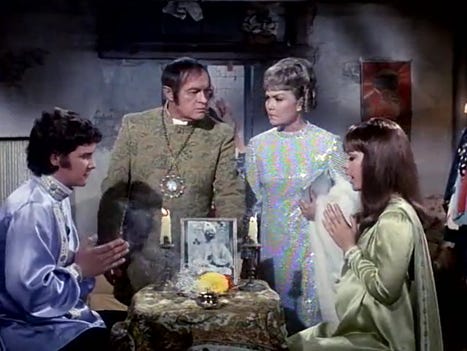
Gleason is nevertheless fun as the unscrupulous rock impresario, managing such bands as the Post-Nasal Drips, the Five Commandments, and the Jefferson Delicatessen. He has a steady girlfriend (Tina Louise, solid here), but is implacably opposed to marriage, and is the one who convinces his son and Hope and Wyman’s daughter not to marry. In this way, the movie is sort of a reverse Graduate, with the older generation breaking up the wedding of the younger. The movie wants to poke fun at the counter-culture, but it is more about the older (male) generation unable to contend with the license and temptations around them. Hope’s advice to his daughter and her husband: “Have children, and be miserable like everybody else.”
At the end, Gleason decides to tie the knot with Tina Louise after all, and of course Hope and Wyman reunite. All is hunky dory, even when Hope and Gleason are caught in another comically timed California mudslide. “Please,” Hope tells Gleason as they float in the mud, “don’t make waves!” in an elbow-jab at (see above) the 1967 movie of that title.
Some Kind of a Nut (1969)
More hi-larious counter-cultural humor, this courtesy of Garson Kanin (who never directed another picture after). Dick Van Dyke is finalizing a divorce with Angie Dickinson. When he grows a beard, hijinks ensue. Because his uptight boss disapproves of the beard, he is fired from his job as a bank teller. His coworkers take his side and go on strike. Van Dyke becomes a cause célèbre. There are speeches about the importance of standing up for individuality against the system. Facial hair was evidently the issue that nearly tore apart the nation at this time.
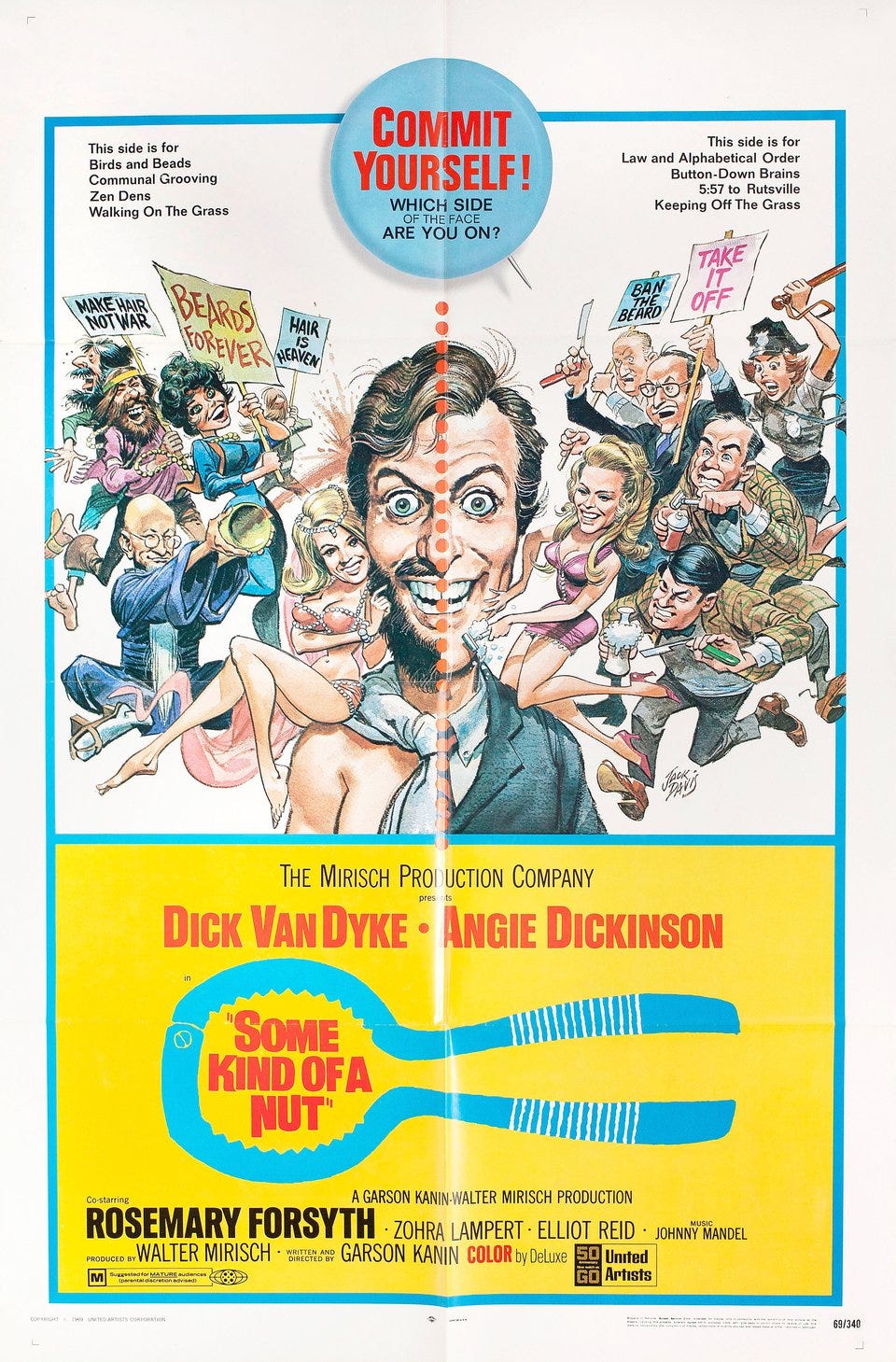
We learn that Van Dyke doesn’t care about the beard. He’s just rebelling against people—especially women—telling him what to do. His new assertiveness is attractive to Dickinson, and they reunite. It’s all pretty bad, with the exception of a hilarious bit with Peter Brocco in yellowface as a Zen teacher.
The Happy Ending (1969)
This is director-writer Richard Brooks’s showcase for his then wife Jean Simmons, and for his own deep ambivalence about marriage. (They subsequently divorced, his third.) With demanding performances (Shirley Jones and Bobby Darin are both excellent), cinematographer Conrad Hall’s masterful use of temperature and shadow, and a Michel Legrand score, The Happy Ending is ambitious but unfocused, full of import and overly tormented. It is a flawed feast.
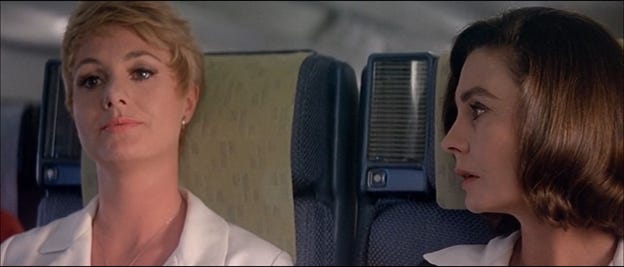
Simmons’s character is a secret drinker who hides vodka bottles in the closet, and is clearly suffering from extreme depression. She and her ally, the family caretaker (Nanette Fabray), both take tranquilizers: “Makes you slender, young, satisfied, and dreary-dull!” The movie opens on the day of her and her husband’s (John Forsythe) wedding anniversary, a fraught occasion since on a previous anniversary she attempted suicide. In a flashback we see her when she was taken via ambulance to the emergency room, where a bored nurse offers the diagnosis: “Vodka and seconal. Marriage on the rocks.”
This year for their anniversary they have a party and fill their house with miserable couples all drinking and smoking and cheating on each other. Dick Shawn gropes various women, and badmouths his wife (Tina Louise, again solid). “She loves you,” Simmons reminds Shawn. He responds with faux profundity: “Love is what we talk about. Sex is what we do.”
The unnecessary straining for profundity is a flaw. For instance, Brooks has lots of American politics in the background: Johnson or Nixon (depending on whether we’re seeing the present or a one-year flashback) on the news, as if this has something central to do with Simmons’s marital unhappiness. After she flees her own party, we see Nixon’s swearing-in on the television.
At least she doesn’t attempt suicide this year. Instead, she hops a flight to the Bahamas. She bumps into an old college friend, an absolutely radiant Shirley Jones. Jones is an escort to wealthy married men. Her current is Lloyd Bridges, who holds forth on marriage being big business. The American economy depends on it, he says: “Bachelors, divorcees, widows, and homosexuals are unprofitable.” Simmons also has a run-in with Bobby Darin, excellent in a role as a gigolo.
Brooks’s argument is not simply with marriage, but with what he takes to be Hollywood’s idea of marriage. He both pays this yearning homage, and frets that it no longer seems to be sustainable for films or in life. Early in the film we see Simmons’s wedding; Brooks superimposes wedding scenes from classic Hollywood films. We get Norma Shearer, Elizabeth Taylor, Garbo. Later in the movie Simmons is lashing out at Forsythe. She hates everything: his career, his life, his religion. “Phony!” she yells at him. She would rather watch old movies on television. They fight, and their words are not those of a married couple but of an angry writer-director.
Forsythe: “Where are you going?”
Simmons: “Back to Casablanca! Back to Humphrey Bogart, Peter Lorre, and Claude Raines.”
Forsythe: “Dead! Dead! Dead!”
Simmons: “Dead and buried, they’re more alive than we are!”
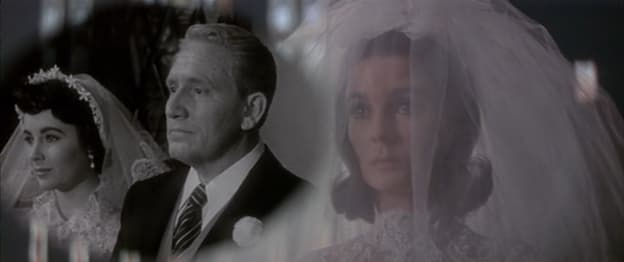
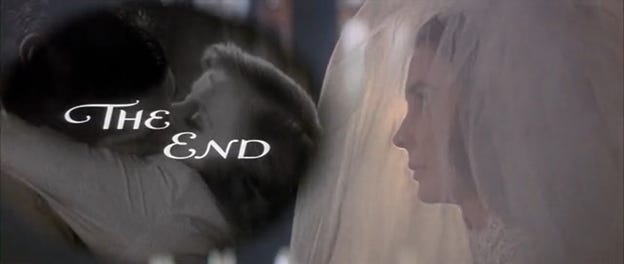
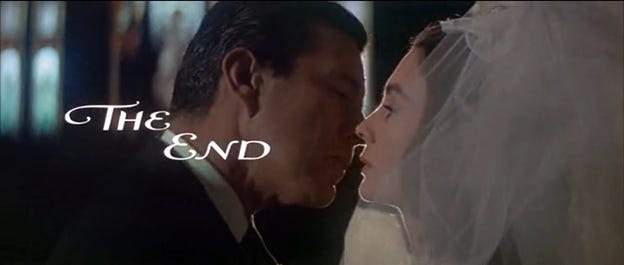
She and Forsythe do finally divorce, and the final minutes of the movie give us just a taste of feminism and 1970s divorce movies to come. Simmons gets a job and goes back to night school to finish the college degree she abandoned when she met her husband. Forsythe bumps into her on campus, and they chat, not without tenderness. “How does it feel to be one of the working class?” he asks. She laughs: “What do you think I’ve been for sixteen years?”
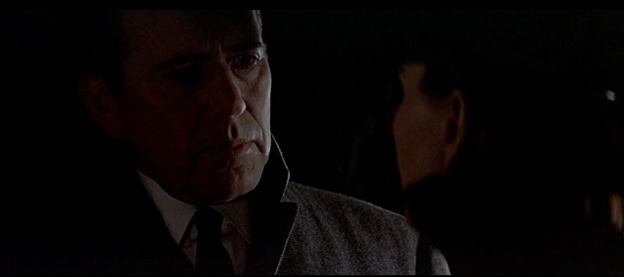
“What happened anyway?” he asks her, running through what we can recognize are all the standard marital challenges in Hollywood movies. “We had no war to keep us apart,” he says. “No mother-in-law problem. No money problem. No sex problem.”
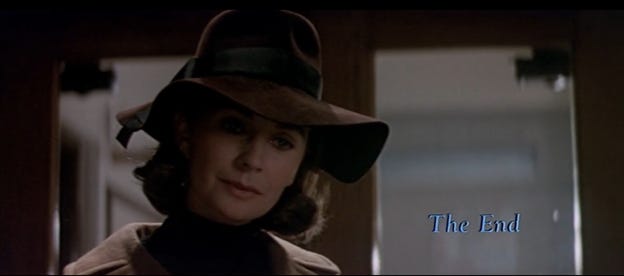
She responds by asking him the new challenge for married people: “If right now we weren’t married, if you were free, would you marry me again?” He can’t answer, which is the answer she expects. We get a “The End” that is quite different from the ones we see in clips from old films on the television. And yet we can’t help but notice that Brooks has filmed this final scene to echo Rick and Ilsa at the end of Casablanca.
Coming Apart (1969)
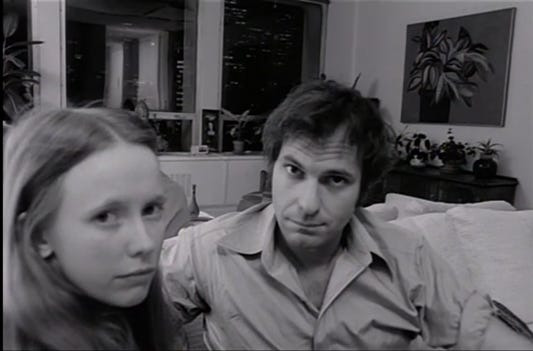
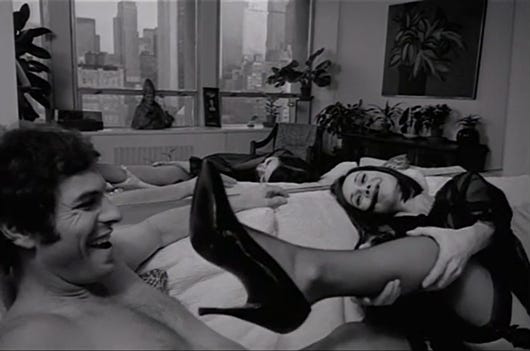
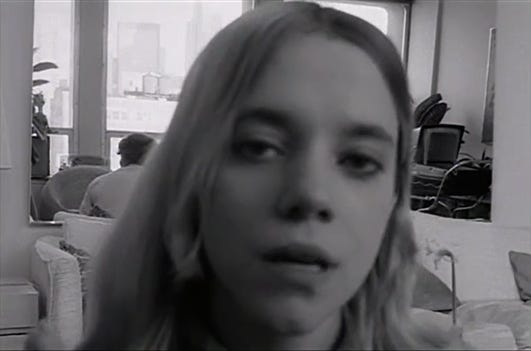
Whatever its flaws and limitations, Moses Milton Ginsberg’s cult movie stands in very finely as an epitome of the whole period: the sex and drugs and rock n roll, the psychic chaos. Rip Torn delivers an extraordinary performance as a married Jewish psychoanalyst going through a personal crisis, who gets an apartment in the building where his ex-lover lives (Viveca Lindfors who, in the screenplay, is supposed to be Israeli). He has a series of bizarre sexual encounters with various women, some his patients, until his wife finally locates him and demands a divorce.
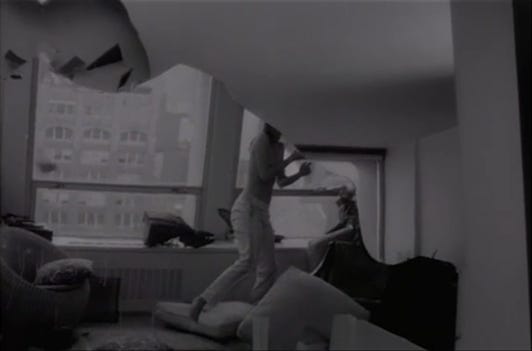
The entire movie is presented as the footage Torn takes with a hidden camera in his apartment, as reflected in a mirror on the opposite wall. The result of this intentional restriction and jerry-rigging is part of the movie’s powerful effect, as is the New York humor, several degrees darker than a Seinfeld. “Where would we get a duck?” is a memorable punchline whose joke I won’t repeat. The movie ends when one of Torn’s lovers, played by Sally Kirkland, trashes his apartment and shatters the mirror.